jbQ Media

Web Design, SEO Services and Media Production | Boston | Suffolk | MA

(917) 861-1242
  • Home
  • About
    • Why Us
    • Jon Burr | Site Designer
    • Our Rates
    • Contact
    • Our Location
    • News via Twitter
  • Our Services
    • WordPress Training
    • WordPress Site Design
    • Website Multimedia Production Services
    • Website Editorial Services
    • SEO Services
    • Online SEO Coaching Services via Zoom
    • Wix SEO Tutorial Services
    • CD Covers and Packages
  • Website Portfolio Gallery
  • Articles
  • Reviews
You are here: Home / Services / Consulting / Edit Canonical Tags per post with Yoast installed | Focus Rank on Landing Pages | Genesis Archive Page

Edit Canonical Tags per post with Yoast installed | Focus Rank on Landing Pages | Genesis Archive Page

October 14, 2014 By Jon Burr 1 Comment

#canonical #duplicate_content

Don’t dilute your link juice and page rank.

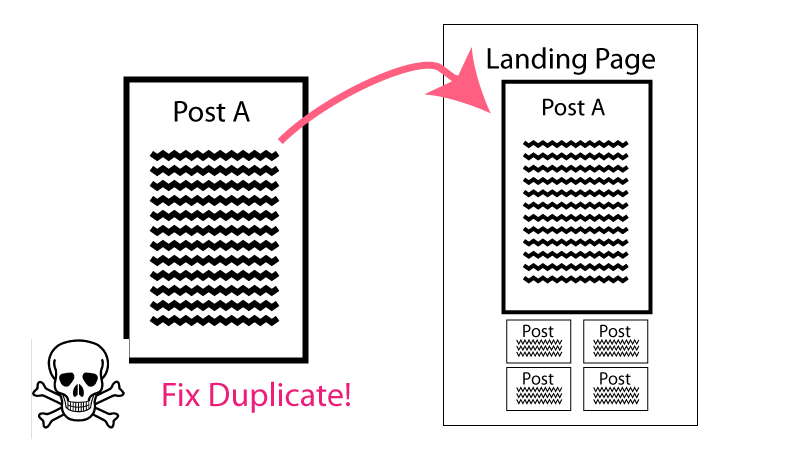
What if you want to display your best post for a category at the top of a Geneses category archive page to make a nice, strong landing page?

Search engines will get confused, not knowing which one to serve. If the rank is split between the two, neither may appear. The entire post will appear in two places on your site. Google, Bing etc won’t know which one to index. It will weaken the rank of both.

Moz has several great articles on Duplicate Content and the use of canonical tags to resolve the problem:

http://moz.com/blog/rel-confused-answers-to-your-rel-canonical-questions

http://moz.com/blog/canonical-url-tag-the-most-important-advancement-in-seo-practices-since-sitemaps

And, Google’s take on frequent mistakes and misuse – (this article is not about one of them!)

http://googlewebmastercentral.blogspot.com/2013/04/5-common-mistakes-with-relcanonical.html

https://support.google.com/webmasters/answer/139066?hl=en

And, Google’s Matt Cutts, chief of WebSpam, on their use:

https://www.mattcutts.com/blog/canonical-link-tag/

But, say you want to show the whole post, as well as excerpts and featured images from all the other posts in the category. A landing page like this can rank well, because all the excerpts are adding keywords and authority to it… if you can define which is the best source of the original content.

Create a landing page with the Genesis Archive template

The landing pages I’m building for several clients use the Genesis Category Archive template.

To make these category archive pages into landing pages, I’ve installed the Genesis Sandbox Featured Content Widget (GSFW) plugin, the Genesis Widgetized Archive (GWA) plugin, and the Dynamic Widgets (DW) plugin. I have Yoast WordPress SEO installed on all sites (always).

The setup begins with the creation of a page assigned to the Genesis Archive template, and given the title of the category to be displayed.

I use one instance of GSFW in the first Archive widget to pull the whole featured post using “include” and the post id. A second instance pulls the loop for the category, using excerpts and featured images, with a one-half column class (optional).

These widgets are constrained to the particular page only using the DW plugin – otherwise they’ll display on all Genesis archive pages.

This works well and makes cool landing pages. The other Archive widgets (there are 3 by default) can display ads or other items on these landing pages.

Refocus Content with Canonical Tags

The source of the content should resolve to the page with the most links and relevant content – which would be the new landing page. The featured post plus all of the excerpts will be more powerful than any particular post. Create a canonical tag on the featured post, pointing to the new landing page.

With Yoast SEO installed, there’s a problem to overcome in rewriting canonical tags, which is that Yoast writes them automatically by default. They have to be disabled on the posts you’re going to feature.

Step One

Remove the canonical tags on the posts you’re going to feature.

How?

Put the following php into your functions.php of your child theme, replacing ### with the post id’s to which you want to add your custom canonicals.

[pastacode lang=”php” message=”Disable Yoast Canonical” highlight=”” provider=”manual”]

//* Stop Yoast from writing canonical tags on specific posts
function wpseo_canonical_exclude( $canonical ) {
		global $post;
		if ( $post->ID == ### ||$post->ID == ### ||$post->ID == ##) {
    		$canonical = false;
    }
	return $canonical;
}
add_filter( 'wpseo_canonical', 'wpseo_canonical_exclude' );

[/pastacode]

(Source: WordPress.com support forum, with a modification for the series)

Step 2

In the post editor, scroll down to find the field “Scripts” (a feature of Genesis) and add your desired canonical tag there.

[pastacode lang=”html” message=”Canonical Link” highlight=”” provider=”manual”]


[/pastacode]

This post has been edited…. the original version suggested using the “Add to Head” WordPress plugin, but thanks to Tom Hickey’s comment on this post on Google+, I found you don’t need a plugin to add your custom canonical tag in Genesis.

This does the trick.

Happy ranking!

Related Posts:

  • Why SEO is Better than Paid Google Ads Search engine optimization (SEO) and paid Google ads (PPC) are…
  • Online SEO Coaching Services via Zoom We Offer Expert Zoom Tutoring in SEO! Unlock the Power…
  • Wix SEO Tutorial Services Lots of options and many things to do! Welcome to…
  • Creating a Glossary for a WordPress Site with ChatGPT AI We created a custom glossary for a WordPress music arranging…
  • CD Covers and Packages Collected past work from a variety of projects we did…

Filed Under: Consulting, SEO, Useful Tools Tagged With: #canonical, #duplicate

Site Search

Our Services

  • WordPress
  • SEO
  • Strategy
  • Consulting
  • Website Design
  • Useful Tools
  • Tutorials
  • Editorial

Comments

  1. James says

    April 12, 2018 at 5:47 am

    Jon, great article! I think not everyone understands the importance of canonical tags. To eliminate duplicate content we can use 301 redirects or canonical tags. In general, it is best to use 301 redirects, but if it is quite difficult, you can use the attribute rel = “canonical”. In my blog – sitechecker.pro/canonical-url/ I described all the mistakes everyone can do in order to avoid them. Hope you’ll find it useful!

    Reply

Leave a Reply Cancel reply

Your email address will not be published. Required fields are marked *

This site uses Akismet to reduce spam. Learn how your comment data is processed.

Recent Articles

  • Why SEO is Better than Paid Google Ads
  • Creating a Glossary for a WordPress Site with ChatGPT AI
  • Converting WordPress Widgets for use in the Block Editor
  • How to Change the Styling of a Column in the WordPress Block Editor
  • Connecting Calendly to Zoom
  • Upgrading an old HTML site with a WordPress blog to WordPress
  • WordPress 5.0 and Gutenberg – What it Means for Genesis Themes
  • Migrating a WordPress Site if Wordfence is Installed, Using Duplicator and MAMP
  • Keeping up with Google’s New Features – SSL, AMP, and Google Posts
  • Adding a full-width responsive header in a Genesis theme (January 2018)
  • LBS Markets Mystery Shopper Fraud
  • Basic SEO In Six Steps
  • Navigating Google My Business, Google Brand Accounts, and Google+
  • SEO Tools Test Drive and Comparison
  • SEO Training | Tutorial | Boston | Suffolk County MA
  • SEO Tools, Links and Learning
  • Certified Google Trusted Photographer | Boston MA
  • Social Media Marketing Services | Facebook Ads Services | Boston | Suffolk County MA
  • What Does SEO Cost?
  • Moving a Live WordPress Site to Local with Mamp Pro

Contact us now! :)

Why delay? Initial consultation is on the house!

call (917) 861-1242

    Your First Name (required)

    Your Last Name (required)

    Your Email (required)

    (please double-check it!)

    Subject

    Contact from jbQ Media Website

    Your Message

    *required


    Subscribe me your mailing list

    Human?*

    • Production
    • WordPress Sites
    • Strategy
    • SEO
    • Websites
    • Editorial
    • Contact
    • Terms of Service
    • Cookie policy

    © 2014 jbQ Media

    Google+
    Manage Cookie Consent
    We use cookies to optimize our website and our service.
    Functional cookies Always active
    The technical storage or access is strictly necessary for the legitimate purpose of enabling the use of a specific service explicitly requested by the subscriber or user, or for the sole purpose of carrying out the transmission of a communication over an electronic communications network.
    Preferences
    The technical storage or access is necessary for the legitimate purpose of storing preferences that are not requested by the subscriber or user.
    Statistics
    The technical storage or access that is used exclusively for statistical purposes. The technical storage or access that is used exclusively for anonymous statistical purposes. Without a subpoena, voluntary compliance on the part of your Internet Service Provider, or additional records from a third party, information stored or retrieved for this purpose alone cannot usually be used to identify you.
    Marketing
    The technical storage or access is required to create user profiles to send advertising, or to track the user on a website or across several websites for similar marketing purposes.
    • Manage options
    • Manage services
    • Manage {vendor_count} vendors
    • Read more about these purposes
    View preferences
    • {title}
    • {title}
    • {title}